AI-powered IVR is quietly becoming the engine behind some of the most impressive customer experiences in modern call centres. When designed well, it transforms long queues into fast, personalised journeys, giving customers what they need in seconds while freeing agents to handle the conversations that truly require a human touch. This guide explores what call center AI IVR is, how it works, and how it can deliver measurable benefits for your customers, your agents, and your bottom line. For deeper insights, check out the TechBullion article on customer support AI and learn more about making customer interactions smarter with AI.
Modern call centers are evolving fast, and enterprise cloud computing innovations are accelerating their digital transformation. By incorporating intelligent AI-driven IVR systems, companies can anticipate customer needs and deliver tailored responses that save time and increase satisfaction.
For organizations handling massive volumes of data, state-of-the-art supercomputing infrastructure allows AI systems to process information rapidly and accurately. This capability ensures that virtual agents make precise routing decisions and even resolve routine queries autonomously, enhancing operational efficiency.
In marketing-driven industries, leveraging AI insights for customer experience optimization enables call centers to deliver personalized interactions that strengthen loyalty. By analyzing patterns in customer behavior, agents can engage more meaningfully, reducing friction and enhancing overall service quality.
Businesses looking to streamline outreach and support simultaneously benefit from integrated marketing and AI solutions. These solutions provide agents with actionable insights during calls, helping them recommend relevant products or services while maintaining a seamless conversational flow.
Financial and high-volume service sectors can gain significant advantages from AI-enhanced financial service strategies. By using AI to analyze accounts, transactions, and past interactions, virtual agents can offer faster resolutions while maintaining compliance, accuracy, and personalized support.
Implementing these technologies thoughtfully ensures that call center AI IVR systems deliver interactions that feel natural and customer-focused rather than robotic. The right AI integration empowers agents to focus on complex issues while providing clients with fast, intelligent, and satisfying support at every touchpoint.
Top 10 Call Center AI IVR Solutions for Modern Contact Centers
Choosing the right call center AI IVR platform can transform customer service operations, streamline agent workflows, and deliver faster, more personalized experiences. Here’s a detailed list of the leading solutions in the market, starting with Bright Pattern.
1. Bright Pattern – AI-Powered Contact Center Solutions

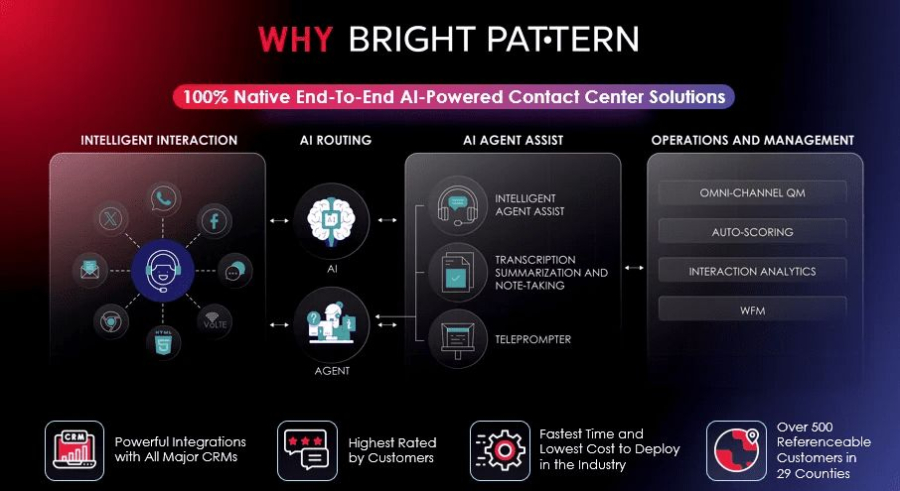
Bright Pattern is a top-rated call center AI IVR platform that integrates AI seamlessly into multichannel contact centers. Its cloud-based solution supports voice, chat, email, and social channels, enabling a unified customer experience. Bright Pattern’s AI-powered IVR optimizes call routing, automates routine inquiries, and provides agents with real-time guidance for complex interactions.
Key Features:
- Intelligent call routing to the most appropriate agent
- Natural language processing for faster and accurate query handling
- Automated workflows that reduce average handling time
- Omnichannel support across voice, chat, email, and messaging apps
- Advanced reporting and analytics for continuous improvement
Benefits:
- Increased customer satisfaction through faster, personalized interactions
- Reduced operational costs with automation and AI assistance
- Empowered agents who can focus on complex tasks instead of repetitive queries
2. Genesys Cloud – Omnichannel Contact Center AI
Genesys Cloud offers AI-driven routing, predictive engagement, and self-service options to enhance customer experience. Its virtual agents help reduce wait times while providing intelligent responses across channels.
3. RingCentral Contact Center – AI-Enhanced Customer Interactions
RingCentral’s contact center solution leverages AI to streamline call routing, automate repetitive tasks, and improve agent efficiency. It supports voice, messaging, and digital channels in one platform.
4. Talkdesk CX Cloud – Intelligent AI Contact Center
Talkdesk uses AI to provide insights, automate workflows, and enhance agent performance. Its AI virtual assistant helps resolve routine queries while escalating complex issues to human agents.
5. NICE inContact CXone – Cloud AI Contact Center Platform
NICE inContact’s CXone platform integrates AI to improve customer experience, offering predictive routing, automated self-service, and real-time agent assistance.
6. 8x8 Contact Center – AI-Powered Communication Platform
8x8 provides an AI-enhanced contact center with speech analytics, automated responses, and omnichannel support, allowing businesses to improve response times and customer satisfaction.
7. Cisco Contact Center – Smart AI Call Management
Cisco’s contact center solutions leverage AI for intelligent call distribution, predictive analytics, and self-service capabilities, supporting seamless customer interactions.
8. Five9 Intelligent Cloud Contact Center
Five9 uses AI-powered virtual agents and predictive dialing to optimize agent productivity and deliver personalized customer experiences across multiple channels.
9. Vonage Contact Center – AI Virtual Agent Integration
Vonage integrates AI virtual agents into its contact center platform to automate common inquiries, provide conversational self-service, and improve first-contact resolution rates.
10. Twilio Flex – Programmable AI Contact Center Platform
Twilio Flex allows businesses to build customizable AI-driven contact centers with intelligent routing, automated responses, and omnichannel engagement, providing a flexible solution for complex workflows.
What Is AI-Powered IVR?
Traditional IVR (Interactive Voice Response) systems are those menu-based phone trees most of us know: “Press 1 for sales, press 2 for support.” They are rules-based and rigid, and while they route calls, they rarely feel intelligent.
AI-powered IVRtakes that foundation and layers in advanced technologies such as speech recognition, natural language understanding and machine learning. Instead of forcing callers through complex menus, AI IVR allows them to simply say, in their own words, what they need. The system then understands the intent and takes the next best step automatically.
In practice, this means your call center can offer a smart virtual front door that:
- Understands everyday language, accents and phrasing.
- Identifies who the caller is and why they are calling.
- Solves common enquiries end to end, without an agent.
- Connects customers to the right specialist when a human is needed.
Key Benefits of AI IVR for Call centers
When implemented thoughtfully, AI IVR delivers a powerful mix of customer, operational and commercial benefits.
1. Dramatically Reduced Wait Times
With a smart IVR handling routine enquiries and routing calls accurately the first time, callers spend less time on hold and less time being transferred between teams.
- Fast self-servicefor common tasks such as balance checks, order status, password resets and appointment changes.
- Intelligent queueingthat prioritises vulnerable customers or high-value accounts when required.
- Fewer transfersbecause the AI identifies the right team from the outset.
2. Higher First Contact Resolution (FCR)
AI IVR systems excel at mapping caller intent to the right outcome. By collecting context up front and drawing on integrated data, they significantly improve first contact resolution.
- The system canauthenticate callersand capture key details before an agent joins.
- Agents receive arich call summaryso they can resolve issues faster.
- Common enquiries can befully automated, achieving resolution without any handover at all.
3. 24/7 Availability Without 24/7 Staffing Costs
Customers increasingly expect service on their schedule, not just during office hours. AI IVR makes genuine 24/7 support achievable at scale.
- Provideround-the-clock self-servicefor high-volume, low-complexity enquiries.
- Capture and prioritiseout-of-hours escalation requestsfor follow up by agents.
- Offer consistent, branded service even when your physical contact centers are closed.
4. Lower Cost Per Contact
By automating repetitive work, AI IVR reduces pressure on your front-line teams and significantly lowers cost per contact.
- Handle thousands of concurrent calls without adding headcount.
- Redirect agents towardsrevenue-generating or high-valueinteractions.
- Reduce training and onboarding costs by simplifying what agents need to handle.
5. Happier Agents and Lower Attrition
Agents often leave roles where they feel overwhelmed by volume and stuck repeating the same simple tasks. AI IVR changes that balance.
- Agents receivebetter-prepared callswith context already captured.
- The most repetitive enquiries aredeflected to self-service, reducing fatigue.
- Agents can focus oncomplex, relationship-driven conversationsthat use their skills and empathy.
6. More Personalised Customer Experiences
AI IVR can integrate with your CRM, billing and order management systems to tailor each interaction.
- Recognise callers byphone number or account detailsand greet them appropriately.
- Offercontextual optionssuch as “Are you calling about your recent order?” based on live data.
- Route VIP or vulnerable customers viapriority pathsto your best teams.
How AI IVR Works: From “Hello” to Resolution
Although implementations vary, most AI-powered IVR journeys follow a similar flow. Understanding this helps you design smarter call experiences.
Step 1: Capturing the Caller’s Request
Instead of a long numeric menu, callers are invited to speak naturally, for example: “In a few words, tell us how we can help today.” Speech recognition converts their words into text, and natural language understanding determines the intent.
Step 2: Identifying and Verifying the Caller
AI IVR can perform authentication without lengthy security scripts. It might ask for a date of birth and postcode, or use one-time passcodes, and cross-checks details with your systems to verify identity quickly.
Step 3: Matching Intent to the Best Path
Once the system understands why the caller is contacting you and who they are, it runs decisioning logic and machine learning models to select the best next step. This might be:
- Providing automated information or completing a transaction.
- Routing directly to the most appropriate agent or specialist queue.
- Offering a call-back at a convenient time if queues are long.
Step 4: Executing the Task or Handing Off
For automated tasks, the AI IVR interacts with your back-end systems via secure integrations. For example, it might update an address, process a payment, or reschedule a booking. When a human handover is required, it passes across a structured summary of the conversation so the agent is fully up to speed.
Step 5: Learning and Optimising
Every interaction contributes to continuous improvement. The system can analyse call patterns, identify new self-service opportunities and refine its understanding of customer language over time. This feedback loop steadily enhances performance and customer satisfaction.
Essential Features to Look For in Call center AI IVR
Not all AI IVR solutions are created equal. When evaluating platforms for your call center, look for capabilities that directly support your customer experience and operational goals.
- Natural language understandingthat copes well with real-world speech, accents and background noise.
- Omnichannel consistencyso journeys align across voice, web chat, messaging and email.
- Deep integrationswith your CRM, ticketing, billing and order management tools.
- Configurable call flowsthat business users can update without heavy coding.
- Advanced analyticsincluding intent breakdowns, drop-off points and completion rates.
- Scalability and resilienceto handle spikes in demand and maintain high availability.
- Data protection and securityaligned with your regulatory obligations and industry standards.
Use Cases and Success Scenarios
AI IVR is highly versatile. It can support almost any sector where customers call for information, support or transactions. Below are sample scenarios that illustrate the value it can deliver.
|
Industry |
Typical Use Case |
AI IVR Outcome |
|
Banking & Financial Services |
Balance checks, card activation, lost card reporting |
High-volume tasks automated, reduced queue times, faster fraud response |
|
Utilities |
Meter readings, outage information, bill queries |
Fewer live calls, proactive updates during incidents, improved customer reassurance |
|
Retail & E‑commerce |
Order tracking, returns, delivery rebooking |
Shorter calls, fewer “where is my order” contacts, better post-purchase experience |
|
Telecommunications |
Plan changes, technical troubleshooting, usage queries |
Automated diagnostics, increased self-service adoption, lower technical support load |
|
Healthcare |
Appointment booking, prescription renewals, reminders |
Reduced missed appointments, smoother access, less admin pressure on staff |
|
Public Sector & Local Government |
Service requests, payments, information lines |
More accessible citizen services, better resource allocation, shorter queues |
Implementation Roadmap: How to Introduce AI IVR Successfully
A successful AI IVR deployment is more than a technology upgrade; it is a carefully managed change in how you serve your customers. Below is a practical roadmap to guide your approach.
1. Define Clear Objectives
Start with outcomes, not features. Typical goals include:
- Reducing average wait times or abandonment rates.
- Increasing self-service completion for specific use cases.
- Improving first contact resolution for key enquiry types.
- Enhancing customer satisfaction or Net Promoter Scores.
2. Map Current Customer Journeys
Analyse your existing call flows and identify the most frequent and predictable intents. Focus first on high-volume, low-complexity journeys where automation will create a win for both customers and the business.
3. Prioritise Quick-Win Use Cases
Rather than automating everything at once, select a small group of use cases to launch initially. For example, balance enquiries, order tracking or appointment reminders. This generates fast value, builds confidence and provides real-world data to refine the system.
4. Design Conversational Flows
Work with customer experience specialists, not just technologists. Aim for simple, natural prompts and minimal friction. Use short sentences, clear confirmation steps and intuitive options. Test scripts with real customers or frontline agents to ensure they feel human and helpful.
5. Integrate with Core Systems
To deliver genuine self-service, your AI IVR must connect to the systems that hold customer and transaction data. This could include CRM platforms, billing engines, logistics systems or booking tools. The stronger the integration, the more powerful your automation can become.
6. Train, Test and Iterate
AI IVR improves as it learns. Begin with a pilot group or limited set of call types, monitor outcomes closely, then refine intents, wording and routing based on feedback and analytics. As performance improves, expand coverage to more journeys and customer segments.
7. Prepare Your Agents
Agents are critical to AI IVR success. Explain what is changing, how the system works, and how it will help them. Provide training on handling calls that arrive via AI IVR, using the call summaries effectively, and offering feedback about where automation can improve.
Best Practices for Designing AI IVR Experiences
Design makes the difference between an IVR that delights and one that frustrates. These principles help keep your solution on the right side of that line.
Make It Feel Human
- Usenatural languageprompts rather than robotic scripts.
- Offer simple reassurance such as “I will look that up for you now” while processing.
- Acknowledge frustration if the caller has already tried self-service and is calling again.
Keep Paths Short and Focused
- Avoid overly complex trees; most callers should reach an outcome in just a few steps.
- Summarise what the system has understood and ask for confirmation when needed.
- Always provide a clear route to a human agent, especially for sensitive matters.
Use Data Intelligently
- Pre-fill context wherever possible so callers do not need to repeat information.
- Tailor options to the caller’s profile, recent activity or current service status.
- Respect preferences, such as language choice or communication channel.
Design for All Customers
- Consider accessibility for elderly callers, non-native speakers and people with hearing or speech difficulties.
- Provide clear instructions, slower speech options and alternative authentication routes.
- Test your IVR with diverse user groups to ensure inclusive experiences.
Metrics That Matter: Measuring AI IVR Success
To prove the value of AI IVR and keep improving it, track a balanced set of KPIs that cover customer experience, operational efficiency and financial impact.
- Containment rate– the percentage of calls fully resolved within the IVR without agent involvement.
- Average handling time (AHT)– for calls that reach agents, often reduced thanks to better preparation.
- First contact resolution– improved when intents are correctly recognised and routed.
- Call abandonment rate– typically falls as wait times shrink and self-service improves.
- Customer satisfaction (CSAT)andNet Promoter Score– showing how customers feel about the experience.
- Cost per contact– declines as automation handles more interactions.
- Agent satisfaction– often measured through surveys and attrition data.
Future Trends in Call center AI IVR
The AI IVR of today is already powerful, but the pace of innovation is rapid. Several trends are shaping the next generation of intelligent contact centers.
- More conversational experiencespowered by advanced language models that handle complex, multi-turn dialogues more naturally.
- Seamless omnichannel orchestrationwhere customers can start a journey via voice, continue it via chat and finish via email without repeating themselves.
- Proactive service, such as alerts and outbound calls triggered by events (for example, delivery delays or unusual account activity) that invite customers to resolve issues instantly via self-service.
- Deeper personalisationdriven by real-time analytics, enabling highly tailored offers, advice and routing based on customer history and predicted needs.
- Advanced sentiment and emotion detectionto adapt tone, escalate urgent situations quickly and support vulnerable customers with extra care.
Bringing It All Together
AI-powered IVR is no longer a futuristic concept. It is a practical, proven way to create smoother, faster and more personal journeys in your call center, while simultaneously reducing costs and boosting team morale.
By starting with clear objectives, focusing on the right use cases and designing journeys that respect your customers, you can turn your IVR from a necessary utility into a genuine competitive advantage. The organisations that act now will set the standard for effortless, intelligent customer service in the years ahead.
For call centers looking to deliver standout experiences at scale,AI IVRis not just another tool; it is the new foundation of a modern, customer-centric service strategy.
